I Cant Wait to Never See My Siblings Again
Brother and sister estrangement is a surprisingly common, and unspoken, occurrence. Why ties break downwardly and how real families reconciled.
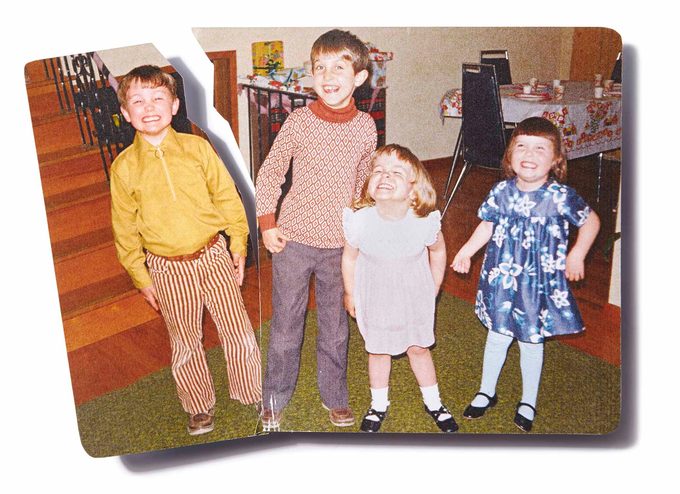
Hope Rising used to dread holiday dinners with her family unit. Her older sister made each repast miserable, with snide comments about nearly everything Rising said or did. Subsequently one peculiarly insult-laden meal, Rising's begetter asked her sister to apologize or leave. She left, husband and kids in tow.
That was when Ascension decided the relationship was over. Information technology took 14 years and a fatal cancer diagnosis for the sisters to speak again.
Claret enemies
In many families, there comes a time when a decision is made that someone is done. Sometimes babyhood dynamics tin metastasize into toxic resentment. Sometimes an awareness dawns that you take never liked the person passing the mashed potatoes and you encounter no reason to continue trekking halfway across the country to see her. Sometimes an aging parent's needs—or the prospect of an inheritance—burn the burner under simmering dysfunction.
The number of Americans who are completely estranged from a sibling is relatively modest—probably less than 5 percentage, says Karl Pillemer, a Cornell University professor. Yet only 26 percent of 18- to 65-yr-olds in an Oakland University survey reported having a highly supportive sibling relationship; 19 pct had an blah relationship, and 16 per centum had a hostile 1.
When University of Pittsburgh psychologist Daniel Shaw, who studies sibling relationships in children, discussed a paper on his research on radio shows, he was surprised to get many calls from adults eager to talk about the pain of their relationships with their sisters and brothers. "Something happened, and they never forgave each other, so now they were calling in … to talk about how they had decided to forgive or how they hadn't spoken for xx or 30 years."
Some people cover up their estrangement because it's catchy or embarrassing to explain. Cynthia Donnelly,* a personal trainer in New York City, used to lie. "I'd say, 'Oh, my blood brother's great, blah blah blah.'" In reality, their human relationship ended three years agone, after she checked her phone in an airdrome and found this message from him: "Hey, if you haven't left yet, I promise your plane crashes."
Although the total break with her brother has been a relief in some ways, Donnelly grieves their human relationship: "It's shameful to tell people who ask, 'Why can't you get along? What's the big deal?'"
How sibling rivalry turns to strife
Every bit kids, brothers and sisters fight. They go aroused for stealing toys or crossing invisible boundaries in the backseat of the car. "The ability to fight with your sibling and resolve those conflicts can be an important developmental achievement," says University of Illinois psychologist Laurie Kramer. Siblings who never acquire to manage these conflicts are almost at risk for adult family unit estrangement, says Katherine Conger, director of the Family unit Inquiry Grouping at the University of California, Davis. "You lot have no incentive to remain in contact. You just desire to stay abroad."
At that place are two personality types who announced prone to being estranged past siblings: those who are extremely hostile and those whom Jeanne Safer, a New York City psychotherapist, calls grievance collectors. "These are the ones who say, 'You lot never thanked me for the flowers I gave yous in 1982.' That wears very thin on people."
Sheryl Booth* has encountered both traits. The youngest of six, Booth was the late-in-life child who unseated her sister as the babe of the family. Since then, Berth feels her sis has resented every positive event in her life—vacations, singing and interim performances, even her decision to take Buddhist vows.
The sight of birthday greetings on Booth's Facebook page sent her sis into a rage. "She put up a bluster on my wall request why people are calling me a friend," Booth says, "considering if merely they knew the truth about me and what a horrible person I am to her, they wouldn't like me." Booth unfriended her sister.
Mom did have a favorite
To some extent, evolution is to arraign. Siblings are hardwired to engage in rivalry considering they compete with one another for one of life's well-nigh disquisitional resources—parental care. "Two hundred years agone, half of all children did not make information technology out of childhood," says Frank Sulloway, a professor of psychology at the University of California, Berkeley. "The intensity of sibling competition makes much more sense when you realize that very small differences in parental favoritism could decide whether a child is taken to a doctor or non."
Two-thirds to three-quarters of mothers have a favorite child, according to Pillemer's research. When favoritism is obvious or is interpreted equally such, siblings are more probable to become estranged.
But many adults shrug off perceived less-favored-child status; others permit information technology fester. The difference is how the siblings feel virtually their adult lives, says psychologist Joshua Coleman, cochair of the Council on Contemporary Families. Those with successful careers and fulfilling lives are less likely to fixate on the past and even enjoy overcoming their "underdog" reputation.
To break upwardly—or make up?
Completely cutting off a sibling, regardless of how much it may be deserved, has serious ramifications, Safer says. Those who initiate family estrangement often feel deep regret later. "We have our parents for xxx to l years, simply we have siblings for 50 to 80 years," she says. "This is the only person who remembers your babyhood, and yous have nothing to say to them? It'due south tragic."
All the people interviewed for this story say they would reconcile—if their siblings apologized and were willing to start fresh. Hope Rising experienced that, though information technology took a tragedy. Last year, her sis was establish to have terminal cancer. Rising flew to Denver to visit: "When I walked into my parents' business firm, she was really happy to see me." Her sister apologized for having treated her so poorly. The sisters talk about in one case a week now. "I'thou glad she had a change of center," Rising says, "simply I'm distressing for the circumstances considering she has less than a yr to alive, and all those years were wasted."
Christine Parizo had cut off her brother afterward he said he couldn't become off piece of work to fly from California to Massachusetts for her daughter's baptism and she discovered he went to Las Vegas instead. But two years later, Parizo agreed to meet him while she was in California on business concern. He explained that her girl's baptism had been during the final stages of his divorce. "I had no idea what he had been going through," she says. After that, Parizo'south blood brother started texting and connecting via Instagram and Facebook. More important, she says, was reclaiming their history. "It's nice to share memories with someone who has the same perspective."
This is one reason, Kramer notes, that fifty-fifty siblings in contentious relationships even so feel pulled to one another. "Some other person knows how your mother gets when she'due south packing for a trip or when the car breaks downwardly," she says. "That shared set up of experiences and that shared agreement are very powerful."
*Proper name has been changed

Source: https://www.rd.com/article/adult-sibling-estrangement/
0 Response to "I Cant Wait to Never See My Siblings Again"
Post a Comment