Can a Woman Go From Brown to Blonde Again
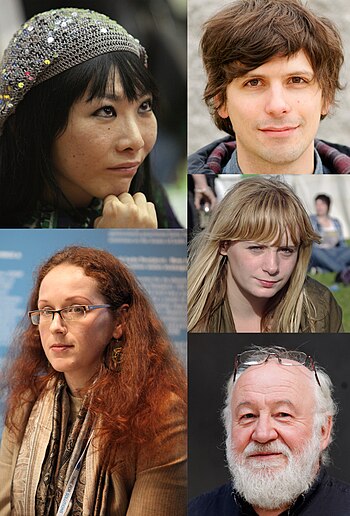
Pilus color is the pigmentation of pilus follicles due to two types of melanin: eumelanin and pheomelanin. Mostly, if more than melanin is present, the color of the hair is darker; if less melanin is present, the hair is lighter. The tone of the hair is dependent on the ratio of black or brown eumelanin to yellow or red pheomelanin. Levels of melanin can vary over time causing a person'south hair color to change, and information technology is possible to have hair follicles of more than one color on the same person. Some pilus colors are associated with some ethnic groups due to observed college frequency of item hair color within their geographical region, eastward.g. straight dark hair amidst Eastward Asians, a big variety of nighttime, fair, curly, wavy and bushy hair amongst Europeans, curly, dark, and uniquely helical hair with Africans, whilst gray, white or "silver" pilus is often associated with historic period and wisdom.
Genetics and biochemistry of hair color [edit]
The total genetic basis of pilus color is complex and not fully understood.[ane] Regulatory Dna is believed to exist closely involved in pigmentation in humans in general,[two] and a 2011 study past Branicki et al. identified 13 Dna variations across 11 dissimilar genes that could be used to predict hair color.[3]
2 types of pigment requite pilus its color, black-chocolate-brown eumelanin and cherry-brown/carmine-yellowish[4] pheomelanin, synthesized by melanocytes.[five] Inside the melanocytes, tyrosine is converted into L-DOPA and then L-dopaquinone, which in plow is formed into pheomelanin or eumelanin.[six]
Dissimilar hair color phenotypes arise primarily as a result of varying ratios of these two pigments in the human population,[5] although Europeans show the greatest range in pigmentation overall.[7] In add-on, other genetic and environmental factors tin can affect hair color in humans; for instance, mutations in the melanocortin 1 receptor (MC1R) gene can lead to red or auburn hair,[v] and exposure to ultraviolet radiation can damage hair and alter its pigmentation.[8] Ultraviolet radiations (UV radiation) triggers greater synthesis of several compounds, including pro-opiomelanocortin (POMC), α-MSH, and ACTH, the end result being increased eumelanin production.[6] UV radiation most commonly comes from the sunday, and thus populations from places closer to the equator tend to accept darker hair,[6] because eumelanin is generally more photoprotective than pheomelanin.[4]
Pheomelanin colors hair orange and red. Eumelanin, which has 2 subtypes of blackness or brown, determines the darkness of the pilus colour;[four] more black eumelanin leads to blacker hair, and more brown eumelanin to browner hair.[6] All homo hair has some amount of both pigments.[ix] Over 95% of melanin content in black and chocolate-brown hair is eumelanin.[nine] Pheomelanin is more often than not found in elevated concentrations in blond and cherry-red pilus,[four] representing about ane-third of total melanin content.[nine] If at that place is no black eumelanin, the result is strawberry blond.[6] blond hair results from small amounts of brown eumelanin with no black eumelanin.[6]
Natural pilus colors [edit]
Natural pilus color tin can exist black, brown, red, blond, or white.
Color shade scale [edit]
The Fischer–Saller scale, named after Eugen Fischer and Karl Saller, is used in concrete anthropology and medicine to make up one's mind the shades of hair color. The scale uses the following designations: A (very light blond), B to E (light blond), F to L (blond), Chiliad to O (night blond), P to T (light brown to brown), U to Y (nighttime dark-brown to black) and Roman numerals I to IV (cherry-red) and V to VI (red blond).[ten]
Image gallery [edit]
-

-
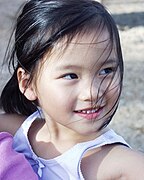
Natural blackness hair
-

Deepest brown hair
-

Dark chocolate-brown pilus
-

Medium brownish pilus
-
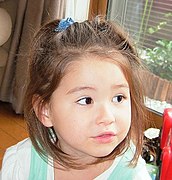
-

Light brown pilus
-

Chestnut brown hair
-
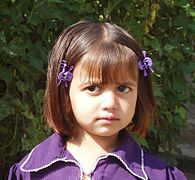
Light chestnut brown hair
-
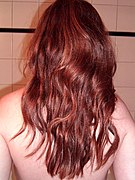
Auburn hair
-

-
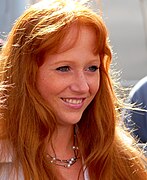
Orange blood-red hair
-

Copper hair
-

-

Strawberry blond hair
-

Light blond hair
-
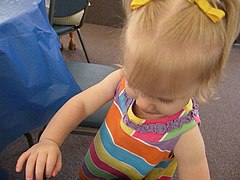
Golden blond hair
-

Medium blond hair
-

Grey pilus
-

White hair
Blackness hair [edit]
Black hair is the darkest hair color. It has large amounts of eumelanin and is more dense than other hair colors.[eleven]
Brown pilus [edit]

Brown hair is the second most mutual human hair color, after blackness. Brown pilus is characterized by higher levels of eumelanin and lower levels of pheomelanin. Of the 2 types of eumelanin (black and brown), dark-brown-haired people accept brown eumelanin; they also commonly have medium-thick strands of hair. Brown-haired girls or women are frequently known equally brunettes.
Anecdote hair is a hair colour which is a reddish shade of dark-brown hair. In contrast to auburn hair, the reddish shade of chestnut is darker. Anecdote hair is common among the native peoples of Northern, Cardinal, Western, and Eastern Europe.
Auburn pilus [edit]
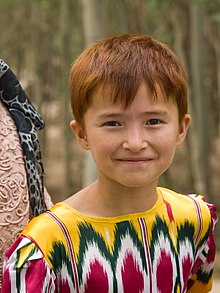
An Uyghur girl with auburn hair
Auburn pilus ranges forth a spectrum of light to nighttime red-chocolate-brown shades. The chemicals which crusade auburn hair are eumelanin (brown) and pheomelanin (red), with a higher proportion of red-causing pheomelanin than is found in average dark-brown hair. It is most commonly constitute in individuals of Northern and Western European descent. Information technology tin can as well exist the result of a mutation in the melanocortin one receptor factor.[5]
Ruby hair [edit]
Cherry hair ranges from lite strawberry blond shades to titian, copper, and completely cherry. Red hair has the highest amounts of pheomelanin, around 67%, and usually low levels of eumelanin. At one–2% of the westward Eurasian population, it is the to the lowest degree common hair color in the world. Information technology is most prominently found in the British Isles and in Udmurtia. Scotland has the highest proportion of redheads; xiii per centum of the population has scarlet hair and approximately twoscore percent comport the recessive redhead gene.[12] [13] [14]
Blond hair [edit]
Blond (sometimes blonde for women) hair ranges from pale white (platinum blond) to dark gilt blond. Strawberry blond, a mixture of blond and cherry pilus, is a much rarer type containing the most pheomelanin.[ citation needed ] Blond pilus can have almost whatsoever proportion of pheomelanin and eumelanin, but has only pocket-sized amounts of both. More than pheomelanin creates a more gilt or strawberry blond color, and more eumelanin creates an ash or sandy blond colour. Blond hair is almost unremarkably found in Northern and Western Europeans and their descendants merely tin exist found spread effectually most of Europe. Studies in 2012 showed that naturally blond hair of Melanesians is caused past a recessive mutation in tyrosinase-related poly peptide i (TYRP1). In the Solomon Islands, 26% of the population bear the factor; withal, it is absent-minded outside of Oceania.[fifteen]
Gray and white hair [edit]

Gray or white hair is not caused by a true grey or white pigment, but is due to a lack of pigmentation and melanin. The articulate hairs appear as gray or white because of the way light is reflected from the hairs. Gray hair color typically occurs naturally as people historic period (see aging or achromotrichia below).
In some cases, gray pilus may be caused by thyroid deficiencies, Waardenburg syndrome or a vitamin B12 deficiency.[sixteen] At some indicate in the man life wheel, cells that are located in the base of operations of the hair's follicles tedious, and eventually stop producing pigment.[17] Piebaldism is a rare autosomal ascendant disorder of melanocyte development, which may cause a built white forelock.[eighteen] : 867
Europeans frequently begin to grow greyness hairs in their mid-30s while Asians begin graying in their late 30s, just well-nigh Africans retain their original hair color until their mid-40s. Permanently white hair starting in childhood can be genetically inherited, but unlike albinism, there are no negative medical implications. The trait follows Ten-linked recessive inheritance, and so is more common in men, and women can be carriers without existence affected.[19] [twenty]
Graying is a gradual process; according to a study by 50'Oreal, overall, of those between 45 and 65 years sometime, 74% had some grayness pilus, covering an average of 27% of their head, and approximately 1 in 10 people had no grey hairs even after the age of 60.[21] [22]
Marie Antoinette syndrome is a proposed phenomenon in which sudden whitening is caused by stress. It has been found that some hairs can become colored again when stress is reduced.[23] [24]
Conditions affecting pilus color [edit]
Aging or achromotrichia [edit]
Children born with some pilus colors may observe information technology gradually darkens equally they grow. Many blond, light dark-brown, or red haired infants experience this. This is acquired past genes being turned on and off during early babyhood and puberty.[25]

A 41-twelvemonth-old man with partially greyness hair
Changes in hair color typically occur naturally as people age, eventually turning the hair gray and then white. This is called achromotrichia. Achromotrichia normally begins in the early to mid-twenties in men and late twenties in women. More than than 60 percent of Americans have some gray hair by age 40. The age at which graying begins seems almost entirely due to genetics. Sometimes people are built-in with greyness hair considering they inherit the trait.[26]
The social club in which graying happens is commonly: olfactory organ hair, pilus on the caput, bristles, torso hair, eyebrows.[27]
In non-balding individuals, pilus may grow faster once it turns gray.[28] Different in the pare where pigment production is continuous, melanogenesis in the pilus is closely associated with stages of the hair wheel. Hair is actively pigmented in the anagen phase and is "turned off" during the catagen phase, and absent during telogen.[29] Thus, a single hair cannot be white on the root side, and colored on the final side.

The same man at age 56, with fully gray hair
Several genes announced to exist responsible for the process of graying. Bcl2 and Bcl-w [30] were the first two discovered, and then in 2016, the IRF4 (interferon regulatory gene iv) gene was appear later on a study of 6,000 people living in five Latin American countries. However, it found that ecology factors controlled almost seventy% of cases of pilus graying.[31]
The change in pilus colour occurs when melanin ceases to exist produced in the pilus root and new hairs abound in without paint. The stem cells at the base of hair follicles produce melanocytes, the cells that produce and shop pigment in hair and skin. The expiry of the melanocyte stalk cells causes the onset of graying. Information technology remains unclear why the stem cells of one hair follicle may fail to activate well over a decade before those in adjacent follicles less than a millimeter apart. Vitamins and minerals that are known to deadening down the graying process are vitamin B-12, C, D, H (Biotin), and the mineral fe.[32] [ unreliable source? ] Also, an abnormal pituitary gland or thyroid gland tin can cause pilus to plow grey.
Graying of hair may be triggered by the accumulation of hydrogen peroxide and abnormally low levels of the enzyme catalase, which breaks down hydrogen peroxide and relieves oxidative stress in patients suffering from vitiligo. Since vitiligo can cause eyelashes to turn white, the aforementioned procedure is believed to be involved in pilus on the caput (and elsewhere) due to aging.[33] [ unreliable source? ]
The anti-cancer drug imatinib has recently been shown to contrary the graying process.[34] Nonetheless, it is expensive and has potentially severe and deadly side effects, so it is not practical to use to alter a person'due south hair color. Nevertheless, if the mechanism of action of imatinib on melanocyte stalk cells can exist discovered, it is possible that a safer and less expensive substitute drug might someday exist developed. It is not yet known whether imatinib has an effect on catalase, or if its reversal of the graying procedure is due to something else.[35]
Stress [edit]
Anecdotes report that stress, both chronic and acute, may induce achromotrichia earlier in individuals than it otherwise would have.[36] Proponents point to survivors of disasters, such as Titanic survivor Harold Bride, pow John McCain, or high-level politicians such equally Bill Clinton or Barack Obama. At that place is some evidence for chronic stress causing premature achromotrichia,[37] merely no definite link has been established. Information technology is known that the stress hormone cortisol accumulates in human being hair over time, simply whether this has any result on hair color has not yet been resolved.[38] A 2022 paper, published in the journal Nature reported that stress tin cause hair to lose its pigment. An overactive immune response can destroy melanocytes and melanocyte stem cells in black-haired rats. When intentionally subjecting them to panic, they bleached their glaze. The next time the rats' glaze grew, there were no melanocyte stalk cells in these damaged follicles, and then white hairs sprouted, and the color loss was permanent.[39]
UV impairment [edit]
Excessive exposure to the lord's day is the most mutual cause of structural harm of the hair shaft. Photochemical hair damage encompasses hair protein deposition and loss, as well as hair pigment deterioration[40] Photobleaching is common amongst people with European beginnings. Around 72 percent of customers who agreed to be involved in a report and accept European ancestry reported in a recent 23andMe inquiry that the sun lightens their hair. The company also have identified 48 genetic markers that may influence hair photobleaching.[41]
Medical weather [edit]
Albinism is a genetic abnormality in which niggling or no pigment is found in human pilus, eyes, and skin. The hair is often white or pale blond. All the same, it can be red, darker blond, low-cal dark-brown, or rarely, even dark brown.
Vitiligo is a patchy loss of hair and skin color that may occur as the result of an motorcar-immune illness. In a preliminary 2013 study, researchers treated the buildup of hydrogen peroxide which causes this with a light-activated pseudo-catalase. This produced significant media coverage that further investigation may someday lead to a general not-dye handling for gray hair.[42]
Malnutrition is likewise known to crusade hair to become lighter, thinner, and more than brittle. Night pilus may plough cherry-red or blondish due to the decreased production of melanin. The condition is reversible with proper nutrition.
Werner syndrome and pernicious anemia can also cause premature graying.
A 2005 uncontrolled study demonstrated that people fifty–lxx years of historic period with dark eyebrows but grey hair are significantly more likely to have type II diabetes than those with both greyness eyebrows and hair.[43]
Artificial factors [edit]
A 1996 British Medical Periodical study establish that tobacco smoking may cause premature graying. Smokers were found to exist 4 times more probable to begin graying prematurely, compared to nonsmokers.[44]
Gray hair may temporarily darken after inflammatory processes, subsequently electron-beam-induced alopecia, and after some chemotherapy regimens. Much remains to be learned about the physiology of human graying.[45]
At that place are no special diets, nutritional supplements, vitamins, or proteins that have been proven to wearisome, stop, or in whatever way affect the graying process, although many have been marketed over the years. However, French scientists treating leukemia patients with imatinib, a new cancer drug, noted an unexpected side effect: some of the patients' hair color was restored to their pre-grey color.[35]
Changes later on decease [edit]
The hair color of buried bodies can alter. Pilus contains a mixture of blackness-dark-brown-yellow eumelanin and red pheomelanin. Eumelanin is less chemically stable than pheomelanin and breaks down faster when oxidized. The color of hair changes faster under extreme conditions. It changes more slowly under dry out oxidizing conditions (such as in burials in sand or in water ice) than nether moisture reducing weather condition (such as burials in wood or plaster coffins).[46]
Hair coloring [edit]

Hair color can be changed by a chemic process. Hair coloring is classed every bit "permanent" or "semi-permanent".
Permanent hair color means that the hair'south structure has been chemically altered until it is eventually cutting away. This does not mean that the synthetic colour will remain permanently. During the procedure, the natural color is removed, one or more than shades, and synthetic color has been put in its identify. All pigments wash out of the cuticle. Natural color stays in much longer and artificial will fade the fastest (depending on the color molecules and the form of the dye pigments).
Permanent hair color gives the almost flexibility because it can brand pilus lighter or darker every bit well every bit changing tone and color, but there are negatives. Abiding (monthly or six-weekly) maintenance is essential to lucifer new hair growing in to the rest of the pilus, and to remedy fading. A one-color permanent dye creates a apartment, uniform color across the whole caput, which can wait unnatural and harsh, especially in a fair shade. To gainsay this, the modern trend is to employ multiple colors—usually 1 color as a base with added highlights or lowlights in other shades.
Semi-permanent colour washes out over a flow of time—typically four to six weeks, and so root regrowth is less noticeable. The final colour of each strand is affected by its original colour and porosity, so there volition be subtle variations in color across the head—more than natural and less harsh than a permanent dye. Still, this means that grayness and white pilus will not dye to the aforementioned color as the residuum of the caput (in fact, some white pilus will non absorb the color at all). A few gray and white hairs will blend in sufficiently not to be noticeable, but as they become more widespread, there will come up a point where a semi-permanent alone will not be enough. The motility to 100% permanent color tin be delayed past using a semi-permanent every bit a base color, with permanent highlights.
Semi-permanent hair color cannot lighten hair.[47] Pilus can simply be lightened using chemical lighteners, such every bit bleach. Bleaching is always permanent considering it removes the natural pigment.
"Rinses" are a form of temporary hair color, usually practical to hair during a shampoo and washed out again the next time the hair is washed.
See besides [edit]
- Human being eye colour
- Human skin colour
References [edit]
- ^ Genetics Abode Reference. "Is hair color determined by genetics?". US National Library of Medicine. Retrieved ten May 2020.
- ^ Pennisi, Elizabeth (one June 2014). "The Genetics of Blond Hair". Scientific discipline Mag. Retrieved ten May 2020.
- ^ Branicki, Wojciech; Liu, Fan; van Duijn, Kate; Draus-Barini, Jolanta; Pośpiech, Ewelina; Walsh, Susan; Kupiec, Tomasz; Wojas-Pelc, Anna; Kayser, Manfred (four January 2011). "Model-based prediction of human pilus color using Deoxyribonucleic acid variants". Human Genetics. 129 (4): 443–454. doi:10.1007/s00439-010-0939-8. PMC3057002. PMID 21197618.
- ^ a b c d Farthmann, B.; Schmitz, S.; Krasagakis, One thousand.; Orfanos, C. E. (1997). "Photoprotection by Full Melanin Content and Pigment Phenotype (Eumelanin, Pheomelanin) in Man Melanoma Cell Lines". Peel Cancer and UV Radiation. pp. 181–185. doi:x.1007/978-3-642-60771-4_21. ISBN978-3-642-64547-1.
- ^ a b c d Kumar, Anagha Bangalore; Shamim, Huma; Nagaraju, Umashankar (2018). "Premature graying of hair: Review with updates". International Journal of Trichology. 10 (5): 198–203. doi:x.4103/ijt.ijt_47_18. PMC6290285. PMID 30607038.
- ^ a b c d e f Schlessinger, Daniel I.; Schlessinger, Joel (January 2020). "Biochemistry, Melanin". StatPearls Publishing. PMID 29083759. Retrieved 22 May 2020.
- ^ Sturm, R. A. (15 Apr 2009). "Molecular genetics of human pigmentation diversity". Human being Molecular Genetics. eighteen (R1): R9–R17. doi:x.1093/hmg/ddp003. PMID 19297406.
- ^ Santos Nogueira, Ana Carolina; Joekes, Ines (May 2004). "Pilus color changes and protein damage caused by ultraviolet radiation". Periodical of Photochemistry and Photobiology B: Biology. 74 (2–3): 109–117. doi:ten.1016/j.jphotobiol.2004.03.001. PMID 15157906.
- ^ a b c Robbins, Clarence R. (2012). Chemic and Physical Behavior of Homo Hair. pp. 315–17. ISBN9783642256103 . Retrieved 22 May 2020.
- ^ "Change in Hair Pigmentation in Children from Birth to five Years in a European Population (Longitudinal Study)". Forensic Science Communications. Archived from the original on 2014-03-20. Retrieved 2014-03-19 .
- ^ Ito, S.; Wakamatsu, K. (2011). "Diversity of human hair pigmentation equally studied by chemic analysis of eumelanin and pheomelanin". Journal of the European University of Dermatology and Venereology. 25 (12): 1369–1380. doi:x.1111/j.1468-3083.2011.04278.10. PMID 22077870. S2CID 5121042.
- ^ "Scientists question whether rare reds are headed for extinction". Azcentral.com. 2005-05-05. Retrieved 2012-04-03 .
- ^ "The Genetics of Red Pilus: What Causes Natural Red Hair?". Brighthub.com. 2009-09-04. Retrieved 2012-04-03 .
- ^ "Michigan twins featured in book about rare scarlet hair". MLive.com. 3 November 2009. Retrieved 2012-04-03 .
- ^ Melanesian blond pilus is caused by an amino acrid modify in TYRP1. Kenny EE, Timpson NJ, Sikora M, Yee MC, Moreno-Estrada A, Eng C, Huntsman S, Burchard EG, Stoneking Yard, Bustamante CD, Myles S (May 2012). "Melanesian blond hair is caused past an amino acid change in TYRP1". Scientific discipline. 336 (6081): 554. Bibcode:2012Sci...336..554K. doi:10.1126/science.1217849. PMC3481182. PMID 22556244.
- ^ Juangbhanich C, Nitidanhaprabhas P, Sirimachan S, Areekul S, Tanphaichitr VS (June 1991). "Vitamin B12 deficiency: report of a babyhood instance". J Med Assoc Thai. 74 (6): 348–54. PMID 1744541.
{{cite journal}}: CS1 maint: uses authors parameter (link) - ^ Weir, Sarah B. (2012-10-02). "Why does hair plow grey?". Yahoo! Lifestyle Great britain. Archived from the original on 2012-10-07. Retrieved 2012-11-10 .
- ^ James, William; Berger, Timothy; Elston, Dirk (2005). Andrews' Diseases of the Skin: Clinical Dermatology (10th ed.). Saunders. ISBN978-0-7216-2921-6.
- ^ "Premature Graying: Reasons, Options". WebMD.
- ^ Burford, Michelle (6 August 2009). "Gray Hair Myths and Facts". AOL Health. Archived from the original on 6 Baronial 2009. Retrieved 6 August 2009.
- ^ Copping, Jasper (30 September 2012). "Grey hair 'less prevalent than previously thought'". The Telegraph. Archived from the original on 2022-01-12. Retrieved 22 January 2017.
- ^ Giana, Bosa. "What Causes Hair To Go White? Let Us Discover The Exact Reasons". gaizupath.com . Retrieved 16 February 2017.
- ^ Alice Klein (June 6, 2020). "Greyness hairs sometimes regain their colour when we feel less stressed". New Scientist.
- ^ Ayelet Rosenberg; et al. (May 19, 2020). "Homo Hair Graying is Naturally Reversible and Linked to Stress". bioRxiv. doi:ten.1101/2020.05.18.101964. S2CID 218764733.
- ^ "Understanding Genetics: Human being Wellness and the Genome". Archived from the original on 2011-07-24. Retrieved 2011-07-25 .
- ^ Pandhi, D; Khanna, D (2013). "Premature graying of hair". Indian Journal of Dermatology, Venereology and Leprology. 79 (5): 641–53. doi:10.4103/0378-6323.116733. PMID 23974581.
- ^ 鼻毛にも白髪は生えるの? (in Japanese). Retrieved 3 July 2012.
- ^ Ralph Thou Trüeb (Jan–Jun 2009). "Oxidative Stress in Ageing of Pilus". Int J Trichology. 1 (ane): half dozen–14. doi:10.4103/0974-7753.51923. PMC2929555. PMID 20805969.
- ^ Slominski A, Paus R. Melanogenesis is coupled to murine anagen: Toward new concepts for the function of melanocytes and the regulation of melanogenesis in pilus growth. J Invest Dermatol. 1993;101:90S–7S
- ^ "Research yields clues to why hair turns grayness". Associated Press. Retrieved 5 August 2011.
- ^ Carina Storrs, Special to CNN (ane March 2016). "Start grey hair cistron found, plucked out of inquiry". CNN.
- ^ "5 Foods That Can Actually Help Foreclose Grey Hair".
- ^ Nsikan Akpan (3 May 2013). "Cure For Gray Pilus Is Almost Here, Vitiligo Study Claims". Medical Daily . Retrieved 17 Jan 2016.
- ^ Etienne, Gabriel; Cony-Makhoul, Pascale; Mahon, François-Xavier (viii August 2002). "Imatinib Mesylate and Greyness Hair". New England Journal of Medicine. 347 (6): 446. doi:10.1056/NEJM200208083470614. PMID 12167692.
- ^ a b "Cancer drug restores pilus colour". BBC News. 2002-08-08.
- ^ Saling, Joseph. "The Effects of Stress on Your Pilus". Web MD. Retrieved fourteen Baronial 2013.
- ^ Ballantyne, Coco. "Fact or Fiction?: Stress Causes Grey Pilus". Scientific American. Retrieved 14 August 2013.
- ^ Robert Preidt (17 April 2013). "Seriously Stressed? Hair Analysis Tells All, Study Finds". WebMD.
- ^ Popular Science, January one, 2020
- ^ Sebetić, Klaudija; Sjerobabski Masnec, Ines; Cavka, Vlatka; Biljan, Darko; Krolo, Ivan (Oct 2008). "UV harm of the pilus". Collegium Antropologicum. 32 Suppl ii: 163–165. ISSN 0350-6134. PMID 19138021.
- ^ 23andMe. "Hair Lightening from the Sunday - 23andMe". www.23andme.com . Retrieved 2020-01-08 .
- ^ Bazian (7 May 2013). "No evidence of cure to prevent pilus going greyness". Filey and Hunmanby Mercury.
- ^ Section of Dermatology, Academic Education Hospital Dresden-Friedrichstadt (xiv December 2005). "Eyebrow color in diabetics". Acta Dermatovenerol Alp Panonica Adriat. 14 (4): 157–threescore. PMID 16435045.
- ^ Mosley JG, Gibbs AC (1996). "Premature grey pilus and hair loss among smokers: a new opportunity for health didactics?". BMJ. 313 (7072): 1616. doi:x.1136/bmj.313.7072.1616. PMC2359122. PMID 8991008.
- ^ Cline DJ (Apr 1988). "Changes in hair color". Dermatol Clin. half-dozen (2): 295–303. doi:x.1016/S0733-8635(18)30675-ii. PMID 3288386.
- ^ "Interactive Dig Hierakonpolis - Archaeological Pilus". Archaeology.org. Retrieved 2012-04-03 .
- ^ Aguh, Crystal; Okoye, Ginette (2016-12-06). Fundamentals of Ethnic Pilus: The Dermatologist'southward Perspective. Springer. ISBN9783319456959.
External links [edit]
Source: https://en.wikipedia.org/wiki/Human_hair_color
0 Response to "Can a Woman Go From Brown to Blonde Again"
Post a Comment