How Did Chincala Become Black Panther Again
The Revolutionary
Power of Black Panther
The outset movie I remember seeing in a theater had a black hero. Lando Calrissian, played by Billy Dee Williams, didn't take any superpowers, but he ran his own city. That moving-picture show, the 1980 Star Wars sequel The Empire Strikes Back, introduced Calrissian as a complicated human being who nonetheless did the right affair. That's 1 reason I grew up knowing I could be the same.
If yous are reading this and y'all are white, seeing people who look like yous in mass media probably isn't something you think about oftentimes. Every day, the culture reflects not only you but about infinite versions of you—executives, poets, garbage collectors, soldiers, nurses and and then on. The earth shows you lot that your possibilities are boundless. Now, after a brief respite, you again have a President.
Those of us who are not white have considerably more trouble not just finding representation of ourselves in mass media and other arenas of public life, merely also finding representation that indicates that our humanity is multifaceted. Relating to characters onscreen is necessary not just for the states to feel seen and understood, but also for others who need to see and understand us. When it doesn't happen, nosotros are all the poorer for it.
This is one of the many reasons Blackness Panther is significant. What seems similar just some other entry in an endless parade of superhero movies is really something much bigger. Information technology hasn't fifty-fifty hit theaters all the same and its cultural footprint is already enormous. Information technology's a movie about what it ways to exist black in both America and Africa—and, more broadly, in the world. Rather than contrivance complicated themes most race and identity, the picture show grapples head-on with the issues affecting modern-twenty-four hour period blackness life. It is also incredibly entertaining, filled with timely comedy, sharply choreographed action and gorgeously lit people of all colors. "You have superhero films that are gritty dramas or action comedies," managing director Ryan Coogler tells TIME. But this movie, he says, tackles some other important genre: "Superhero films that deal with issues of being of African descent."
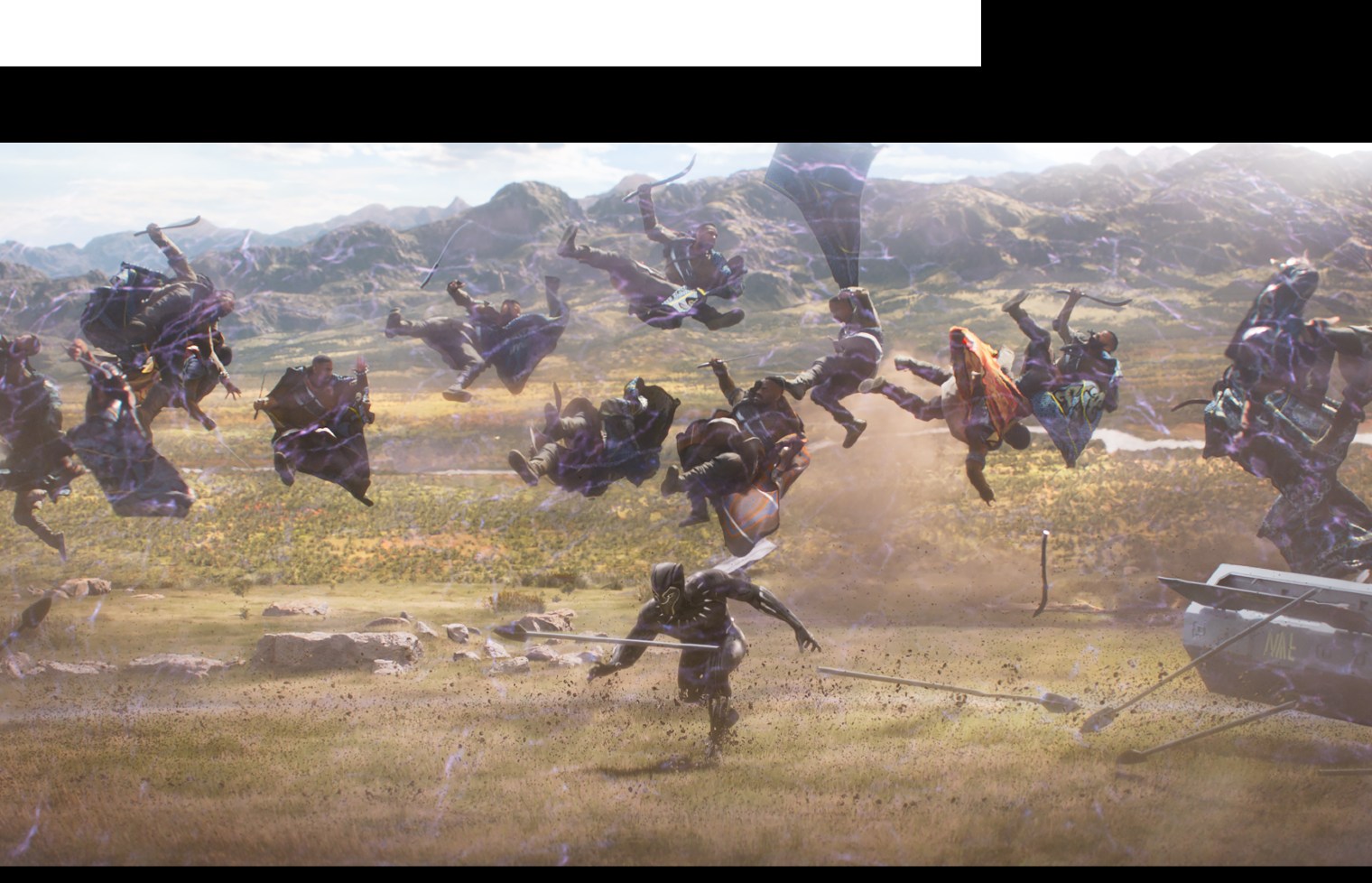
Black Panther is the 18th movie in the Curiosity Cinematic Universe, a franchise that has made $13.5 billion at the global box office over the past 10 years. (Curiosity is endemic past Disney.) It may be the beginning megabudget moving picture—not just about superheroes, only virtually anyone—to have an African-American director and a predominantly black cast. Hollywood has never produced a blockbuster this splendidly black.
The pic, out Feb. xvi, comes equally the entertainment industry is wrestling with its toxic handling of women and persons of colour. This rapidly expanding reckoning—i that reflects the importance of representation in our civilisation—is long overdue. Blackness Panther is poised to show to Hollywood that African-American narratives have the power to generate profits from all audiences. And, more than of import, that making movies about blackness lives is part of showing that they matter.
The invitation to the Black Panther premiere read "Royal attire requested." However no one showed up to the Dolby Theatre on Hollywood Boulevard on January. 29 looking like an extra from a British costume drama. On display instead were crowns of a different sort—ascending caput wraps made of diverse African fabrics. Oscar winner Lupita Nyong'o wore her natural hair tightly wrapped above a resplendent bejeweled purple gown. Men, including star Chadwick Boseman and Coogler, wore Afrocentric patterns and clothing, dashikis and boubous. Co-star Daniel Kaluuya, an Oscar nominee for his star turn in Get Out, arrived wearing a kanzu, the formal tunic of his Ugandan ancestry.
Afterwards the Obama era, perhaps none of this should feel groundbreaking. But it does. In the midst of a regressive cultural and political moment fueled in role by the white-nativist movement, the very existence of Blackness Panther feels like resistance. Its themes challenge institutional bias, its characters take unsubtle digs at oppressors, and its narrative includes prismatic perspectives on black life and tradition. The fact that Blackness Panther is splendid merely helps.
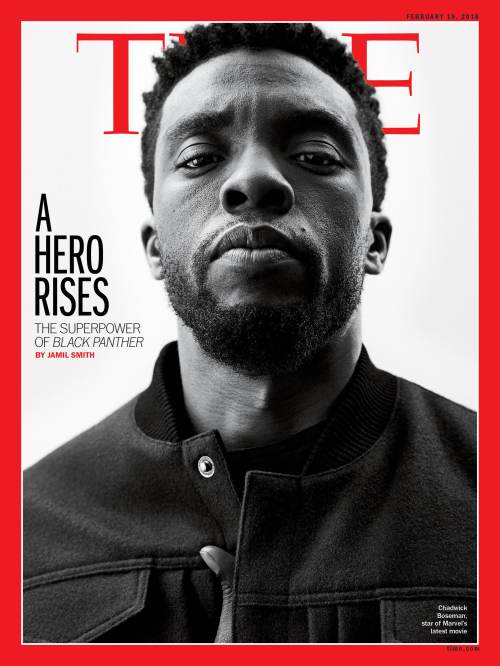
Back when the motion picture was announced, in 2014, nobody knew that it would be released into the fraught climate of President Trump'due south America—where a thriving black future seems more than difficult to meet. Trump's reaction to the Charlottesville anarchy last summer equated those protesting racism with violent neo-Nazis defending a statue honoring a Confederate general. Immigrants from Mexico, Central America and predominantly Muslim countries are some of the President's almost frequent scapegoats. And then what does it hateful to see this film, a vision of unmitigated black excellence, in a moment when the Commander in Main reportedly, in a contempo meeting, dismissed the 54 nations of Africa as "sh-thole countries"?
As is typical of the climate nosotros're in, Blackness Panther is already running into its share of trolls—including a Facebook grouping that sought, unsuccessfully, to alluvion the review aggregator Rotten Tomatoes with negative ratings of the picture. That Black Panther signifies a threat to some is unsurprising. A fictional African Rex with the technological war power to destroy you—or, worse, the wealth to buy your land—may not delight someone who but wants to consume the latest Marvel chapter without deeper political consideration. Black Panther is emblematic of the most productive responses to bigotry: rather than going for hearts and minds of racists, it celebrates what those who cull to prohibit equal representation and rights are ignoring, willfully or not. They are missing out on the full possibility of the earth and the very America they seek to make "great." They cannot terminate this representation of it. When considering the folks who preemptively detest Black Panther and seek to stop it from influencing American civilization, I repeat the response that the movie's hero T'Challa is known to give when warned of those who seek to invade his habitation country: Let them try.
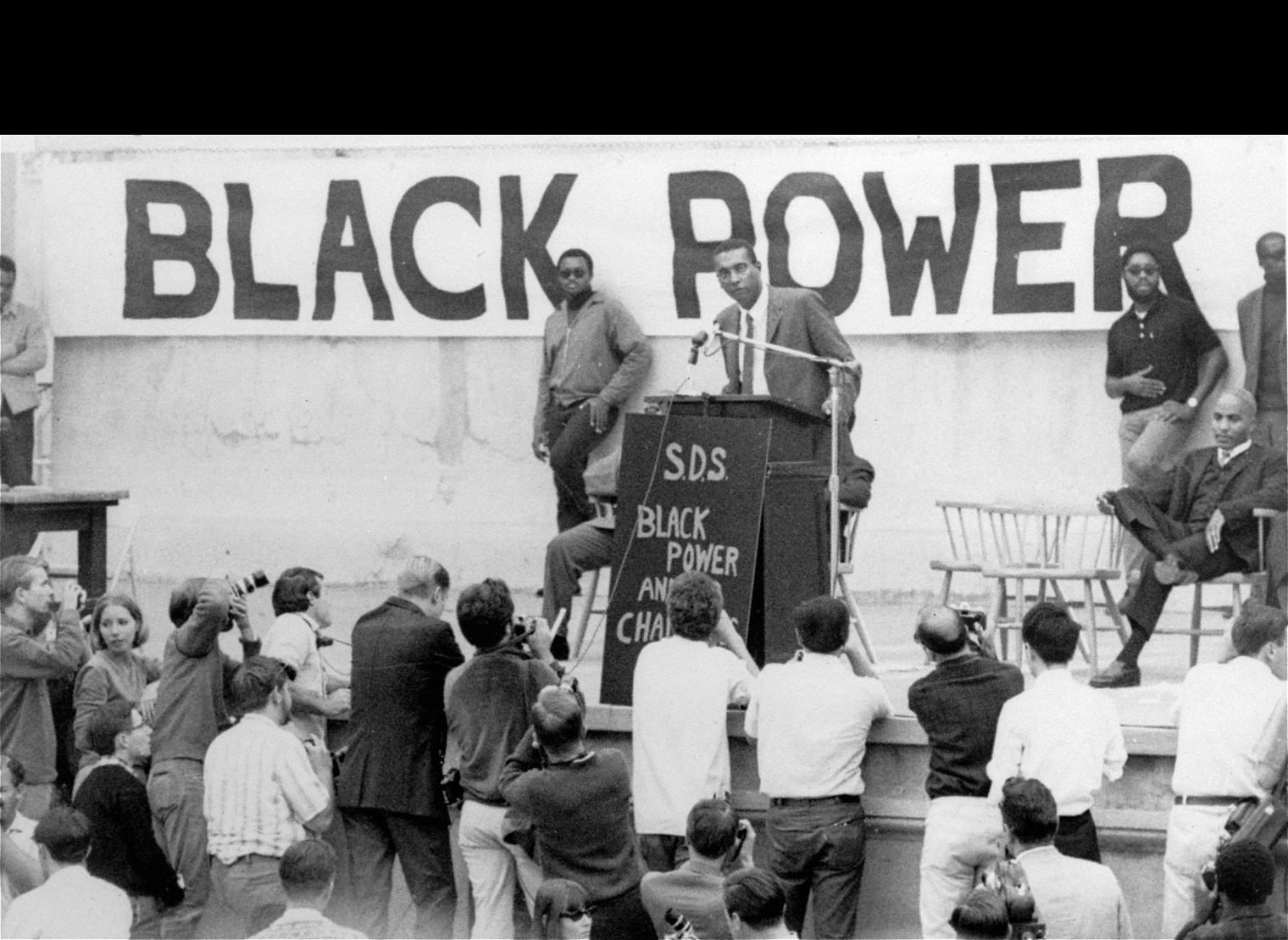
The history of black power and the movement that diameter its proper noun can be traced back to the summer of 1966. The activist Stokely Carmichael was searching for something more than than mere liberty. To him, integration in a white-dominated America meant assimilation past default. About i year after the bump-off of Malcolm X and the Watts riots in Los Angeles, Carmichael took over the Student Nonviolent Coordinating Committee from John Lewis. Carmichael decided to motility the arrangement away from a philosophy of pacifism and escalate the group's militancy to emphasize armed cocky-defense, black business ownership and community control.
In June of that yr, James Meredith, an activist who four years before had go the first black person admitted to Ole Miss, started the March Against Fear, a long walk of protestation from Memphis to Mississippi, lonely. On the second day of the march, he was wounded by a gunman. Carmichael and tens of thousands of others continued in Meredith's absenteeism. Carmichael, who was arrested halfway through the march, was incensed upon his release. "The only way nosotros gonna stop them white men from whuppin' us is to take over," he declared earlier a passionate oversupply on June 16. "Nosotros been saying freedom for 6 years and nosotros ain't got nothin'. What nosotros gonna get-go sayin' now is Black Ability!"
Black Panther was built-in in the civil rights era, and he reflected the politics of that fourth dimension. The month afterwards Carmichael's Black Power declaration, the character debuted in Curiosity Comics' Fantastic Four No. 52. Supernatural force and agility were his main features, but a genius intellect was his all-time attribute. "Black Panther" wasn't an alter ego; it was the formal title for T'Challa, Rex of Wakanda, a fictional African nation that, thank you to its exclusive hold on the sound-absorbent metal vibranium, had become the nearly technologically advanced nation in the world.
Information technology was a vision of blackness grandeur and, indeed, ability in a trying fourth dimension, when more than 41% of African Americans were at or below the poverty line and comprised nigh a tertiary of the nation's poor. Much like the iconic Lieutenant Uhura character, played by Nichelle Nichols, that debuted in Star Expedition in September 1966, Blackness Panther was an expression of Afrofuturism—an ethos that fuses African mythologies, technology and science fiction and serves to rebuke conventional depictions of (or, worse, efforts to bring about) a future bereft of black people. His white creators, Stan Lee and Jack Kirby, did not consciously conjure a fantasy-globe response to Carmichael's call, but the prototype even so held power. T'Challa was non only strong and educated; he was as well royalty. He didn't have to accept over. He was already in charge.
"Y'all might say that this African nation is fantasy," says Boseman, who portrays T'Challa in the moving picture. "Only to have the opportunity to pull from real ideas, real places and real African concepts, and put it inside of this idea of Wakanda—that'south a great opportunity to develop a sense of what that identity is, particularly when you're disconnected from information technology."
The character emerged at a time when the civil rights movement rightfully began to increase its demands of an America that had promised and so much and delivered so niggling to its blackness population. Fifty-two years afterwards the introduction of T'Challa, those demands have yet to be fully answered. According to the Federal Reserve, the typical African-American family had a median net worth of $17,600 in 2016. In dissimilarity, white households had a median net worth of $171,000. The revolutionary thing about Black Panther is that it envisions a world not devoid of racism but i in which black people take the wealth, applied science and military might to level the playing field—a scenario applicative not only to the predominantly white landscape of Hollywood but, more than important, to the globe at large.
The Black Panther Party, the revolutionary organization founded in Oakland, Calif., a few months afterwards T'Challa's debut, was depicted in the media as a threatening and radical grouping with goals that differed dramatically from the more pacifist vision of civil rights leaders like Martin Luther King Jr. and Lewis. Curiosity even briefly changed the graphic symbol's name to Blackness Leopard considering of the inevitable association with the Panthers, but before long reverted. For some viewers, "Black Panther" may have undeservedly sinister connotations, but the 2022 film reclaims the symbol to be celebrated by all as an avatar for change.
The urgency for change is partly what Carmichael was trying to express in the summer of '66, and the powers that exist needed to listen. Information technology'due south still true in 2018.
Moviegoers get-go encountered Boseman's T'Challa in Marvel'due south 2022 ensemble hit Captain America: Civil War, and he instantly cut a hitting effigy in his sleek vibranium suit. Equally Blackness Panther opens, with T'Challa grieving the death of his father and coming to grips with his sudden ascension to the Wakandan throne, information technology'southward articulate that our hero'due south royal upbringing has kept him sheltered from the realities of how systemic racism has touched merely about every black life across the world.
The comic, specially in its virtually recent incarnations as rendered past the writers Ta-Nehisi Coates and Roxane Gay, has worked to expunge Euroaxial misconceptions of Africa—and the film's imagery and thematic material follow accommodate. "People often ask, 'What is Black Panther? What is his power?' And they have a misconception that he but has power through his suit," says Boseman. "The character is existing with ability inside power."
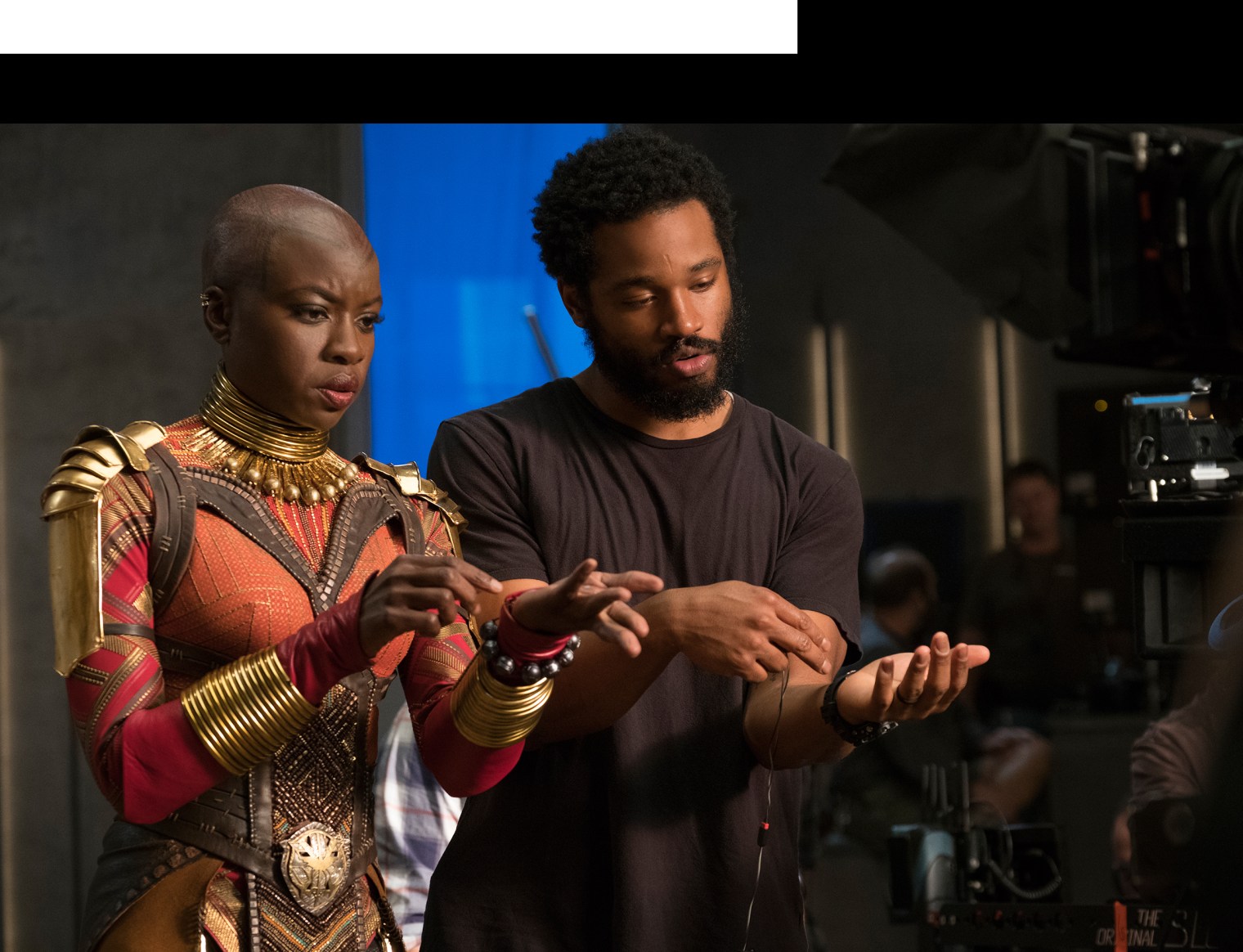
Coogler says that Black Panther, like his previous films—including the police-brutality drama Fruitvale Station and his innovative Rocky sequel Creed—explores problems of identity. "That'southward something I've always struggled with equally a person," says the managing director. "Similar the first time that I found out I was black." He's talking less almost an epidermal self-awareness than about learning how white gild views his blackness pare. "Not just identity, just names. 'Who are you?' is a question that comes upward a lot in this motion-picture show. T'Challa knows exactly who he is. The antagonist in this motion-picture show has many names."
That villain comes in the form of Erik "Killmonger" Stevens, a erstwhile blackness-ops soldier with Wakandan ties who seeks to both outwit and beat out downwardly T'Challa for the crown. Equally played by a scene-stealing Michael B. Hashemite kingdom of jordan, Killmonger's motivations illuminate thorny questions near how black people worldwide should best utilize their power.
In the picture show, Killmonger is, like Coogler, a native of Oakland. By exploring the disparate experiences of Africans and African Americans, Coogler shines a bright light on the psychic scars of slavery's legacy and how black Americans suffer the real-life consequences of it in the present day. Killmonger's perspective is rendered in total; his rage over how he and other black people across the earth have been disenfranchised and disempowered is justifiable.
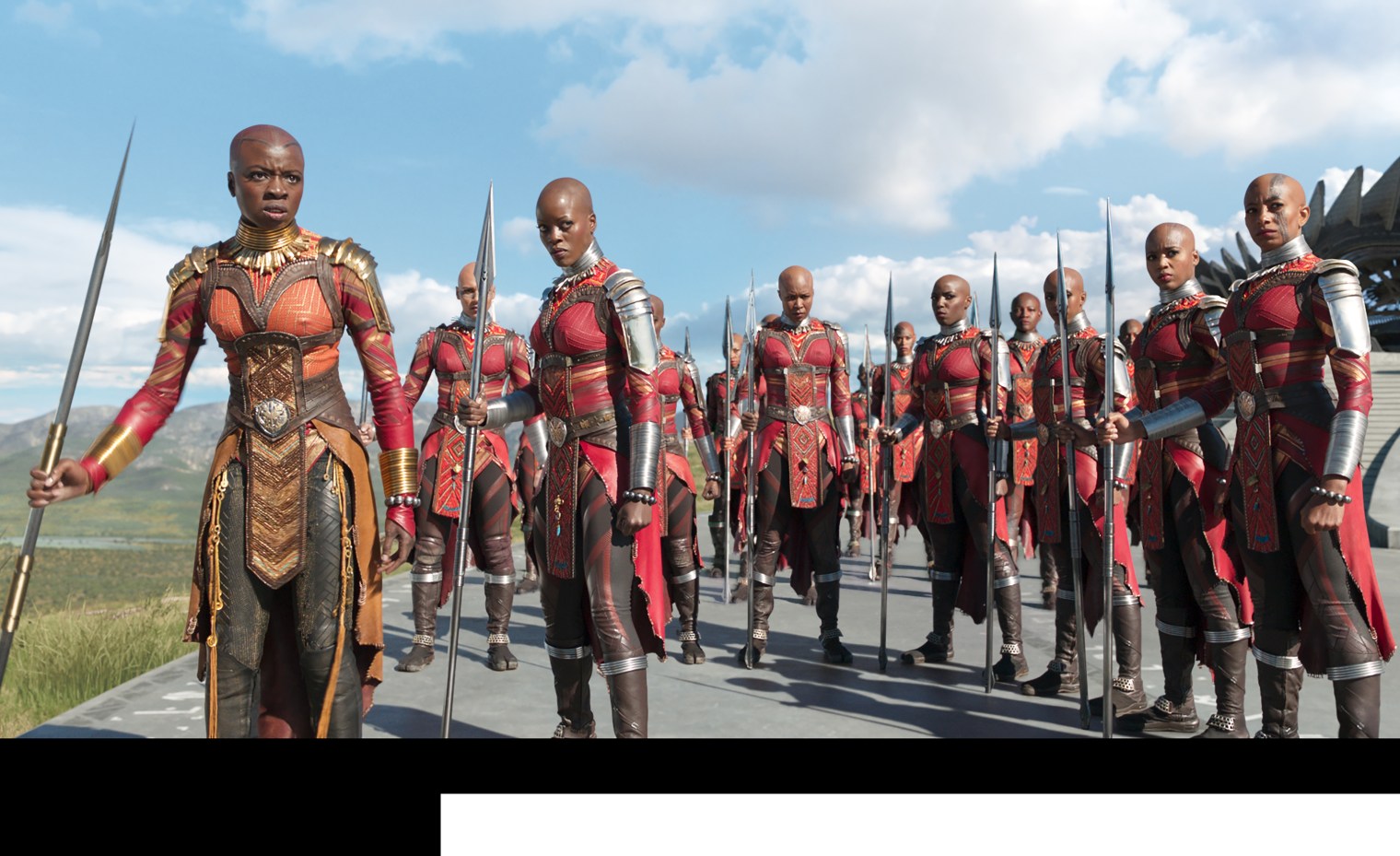
Coogler, who co-wrote the screenplay with Joe Robert Cole, besides includes another important antagonist from the comics: the dastardly and narrow-minded Ulysses Klaue (Andy Serkis). "What I love about this experience is that information technology could take been the idea of black exploitation: he's gonna fight Klaue, he'south gonna go subsequently the white man and that's it—that's the enemy," Boseman says. He recognizes that some fans will take issue with a black male villain fighting black protagonists. Killmonger fights not only T'Challa, but besides warrior women like the spy Nakia (Nyong'o), Okoye (Danai Gurira) and the rest of the Dora Milaje, T'Challa'south all-female royal guards. Killmonger and Shuri (Letitia Wright), T'Challa's quippy tech-genius sister, also confront off.
T'Challa and Killmonger are mirror images, separated only by the accident of where they were born. "What they don't realize," Boseman says, "is that the greatest disharmonize you will ever face will be the disharmonize with yourself."
Both T'Challa and Killmonger had to be compelling in order for the movie to succeed. "Apparently, the superhero is who puts you in the seat," Coogler says.
"That'south who you lot want to meet come up out on acme. Simply I'll exist damned if the villains ain't cool also. They have to be able to stand up to the hero, and take y'all saying, 'Human, I don't know if the hero'due south going to go far out of this.'"
"If you don't have that," Boseman says, "you don't have a picture show."
This is not merely a movie nigh a black superhero; information technology'due south very much a black movie. It carries a weight that neither Thor nor Captain America could elevator: serving a black audition that has long gone underrepresented. For so long, films that depict a reality where whiteness isn't the default take been ghettoized, marketed largely to audiences of colour every bit niche entertainment, instead of as role of the mainstream. Recall of Tyler Perry's Madea movies, Malcolm D. Lee'south surprise 1999 hitting The Best Man or the Barbershop franchise that launched in 2002. Only over the past year, the success of films including Get Out and Girls Trip have done fifty-fifty bigger business organization at the box office, led to commercial acclaim and minted new stars like Kaluuya and Tiffany Haddish. Those 2 hits have but bolstered an argument that has persisted since well before Spike Lee fabricated his debut: black films with black themes and black stars tin and should be marketed like any other. No 1 talks about Woody Allen and Wes Anderson movies as "white movies" to be marketed only to that audience.
Blackness Panther marks the biggest move yet in this wave: information technology'due south both a black film and the newest entrant in the most bankable movie franchise in history. For a wary and risk-averse film business, led largely by white moving-picture show executives who have been historically predisposed to greenlight projects featuring characters who look like them, Black Panther will offer proof that a depiction of a reality of something other than whiteness tin can brand a ton of coin.
The film's positive reception—as of Feb. 6, the day initial reviews surfaced, it had a 100% rating on Rotten Tomatoes—bodes well for its commercial prospects. Diversity predicted that information technology could threaten the Presidents' Mean solar day weekend record of $152 million, fix in 2022 by Deadpool.
Some of the moving-picture show's early on success can be credited to Nate Moore, an African-American executive producer in Curiosity'southward film division who has been vocal about the importance of including black characters in the Curiosity universe. But beyond Wakanda, the questions of power and responsibleness, it seems, are non just applicable to the characters in Blackness Panther. In one case this film blows the doors off, as expected, Hollywood must do more than to reckon with that issue than merely greenlight more than blackness stories. It also needs more Nate Moores.
"I know people [in the amusement manufacture] are going to run into this and aspire to it," Boseman says. "Only this is also having people inside spaces—gatekeeper positions, people who can open up doors and take that idea. How can this be done? How can we be represented in a style that is aspirational?"
Because Black Panther marks such an unprecedented moment that excitement for the film feels almost kinetic. Black Panther parties are being organized, pre- and mail-flick soirées for fans new and quondam. A video of immature Atlanta students dancing in their classroom in one case they learned they were going to see the motion picture together went viral in early February. Oscar winner Octavia Spencer announced on her Instagram account that she'll be in Mississippi when Black Panther opens and that she plans to purchase out a theater "in an underserved community there to ensure that all our brown children tin see themselves every bit a superhero."
Many civil rights pioneers and other trailblazing forebears have received lavish cinematic treatments, in films including Malcolm X, Selma and Hidden Figures. Jackie Robinson even portrayed himself onscreen. Fictional celluloid champions have included Virgil Tibbs, John Shaft and Foxy Brown. Lando, also. But Black Panther matters more, because he is our best chance for people of every color to see a black hero. That is its own kind of ability.
Jamil Smith is a journalist born and raised in Cleveland, Ohio. He lives in Los Angeles.
Source: https://time.com/black-panther/
0 Response to "How Did Chincala Become Black Panther Again"
Post a Comment